CCHE3D

Testing & Validation (3.2MB)
Engineering Applications (2MB)
 

Introduction

CCHE3D is a three dimensional numerical simulation model, it is a software package designed for simulating free surface turbulent flows with sediment transport, pollutant transport, and water quality analysis capabilities. Full Reynolds equations are solved using Efficient Element Method, a collocation approach of the finite element method. Several turbulence closure schemes are available for users to select for their applications. The model can be used for both small scaled near field, detailed flows and sediment transport analyses and large scale engineering applications.


Main features of the flow model

The finite element transformation allows the model to be applied to cases with complex natural geometric and topographic domains. Mixed with the finite volume approach, mass conservation is preserved both locally and globally.

Structured grid is used for discretize computational domain and the differential equations. Partially staggered grid is used for solving pressure field to eliminate oscillation. Equation systems are solved implicitly with the SIP method.

Unsteady governing equations are solved for both steady and unsteady cases. Free surface is computed with the free surface kinematic equation.

Boussinesq’s assumptions is used to formulate turbulence stresses. Several turbulence closure schemes are available including two zero equation models: parabolic and mixing length models; and four two equation models: standard k-e model, RNG k-ε model, k-ω model and non-linear k-ε model. Simpler models are for efficient studies, the more complex models resolve more details of the flow distributions.

Wall function can be applied as boundary conditions for vertical walls as well as for irregular bed surface. For applications with large scale computational domain and sparse mesh near the boundaries, a simple slip and partial slip boundary condition can be available.

For many open channel flow and sediment transport studies, the hydrostatic pressure assumption is valid; the dynamic pressure becomes very important when three-dimensionality and vertical acceleration of the flow are strong. Options for computing both pressures are made available in the CCHE3D model.

Convective interpolation function is used for handling upwinding, which varies with the local Peclet number. Several other upwinding schemes are also available including the first order, second order upwinding and QUICK schemes.


Model verification and validation

A numerical model is a tool developed for solving partial differential equations. The process of the development is complicated involving several steps: deriving mathematic equations, discretizing mathematic equations, formulating numerical schemes, solving (algebraic) equation systems, and programming computer codes, etc. Errors are often made in the process creating a model.

To detect the errors, a model has to be tested for its integrity: to verify it is mathematically correct using analytical method, to validate it is capable of reproducing physical mechanisms using physical model data and to prove it is applicable to real world problems and have realistic results using field data. CCHE3D model has been tested using this procedure with many test cases in the past, and its being tested for more cases.


Mesh generator and Graphic User Interface

CCHE3D uses structured quadrilateral mesh horizontal plane, the mesh generator for the CCHE2D can be used directly for generating meshes for the 3D model. There are three ways for users to determine the vertical distribution of the 3D mesh: using exponent function provided by the model (uniform for all nodes); self determined distribution (uniform for all nodes); the third distribution user determined non-uniform (vary from node to node) distribution. 


Current status of the CCHE3D model

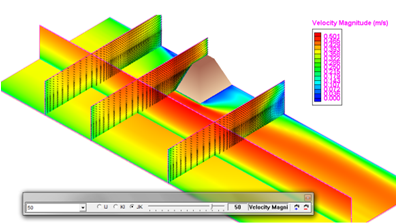
The graphic user interface for the CCHE3D is under development, which provides a convenient tool for specifying modeling parameters, boundary conditions, for visualizing the computation results of flow and other variables. We will keep updating this site to keep interested users informed.